
ATET legal mess lays bare major questions for the City of Melbourne
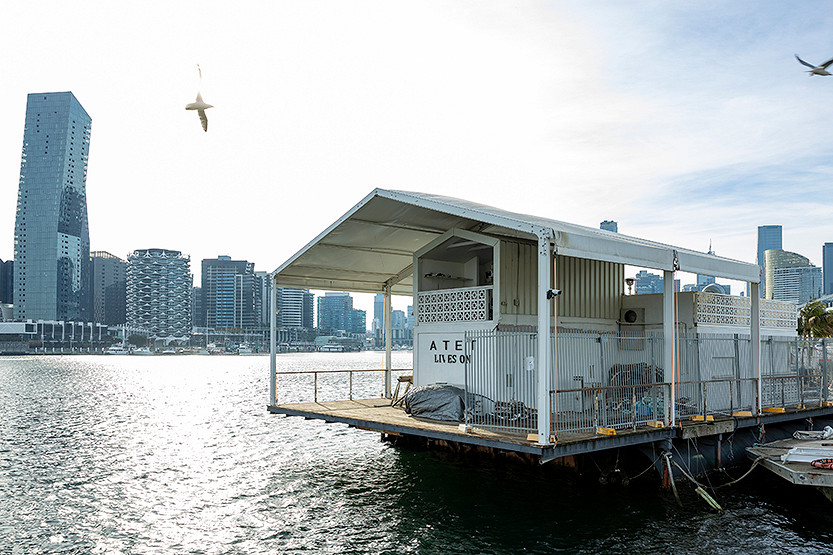

The $7 million Supreme Court fight over Docklands floating events space ATET has now reached the point where the City of Melbourne can no longer plausibly present it as just another difficult regulatory dispute.
The council has admitted liability. Its barrister then returned to court two days later trying to narrow what that admission meant. The case is now delayed again, the trial has become part-heard, and ratepayers are left staring at what could be a very large compensation bill, plus years of legal costs, in a saga that should never have been allowed to spiral this far.
That is now the central fact around which all the other questions sit.
How did the council allow this to drag on for so long? Why, having now admitted liability in open court, did it not settle the matter? If the city knew throughout that the venue had been operating within the relevant noise framework, why did it push ahead with steps that have now resulted in an admission of unlawful termination?
And, most importantly for the public, who is accountable for creating a situation in which millions of dollars may now be paid out over the mishandling of one Docklands venue?
Those are not rhetorical questions anymore. They are the understandable questions that now flow from the council’s own conduct in court.
The pivotal moment came on April 21, day six of the trial, when legal counsel for the City Jonathan Wilkinson told Justice Matthew Connock: “Council admits liability on the plaintiffs’ pleaded claim.” He added that further evidence on liability was no longer required and that the case would proceed on the question of quantum only.
That was a profound concession. It meant the City was no longer contesting the heart of the case. The judge immediately pressed for clarity, observing that an admission of liability on the pleaded claims appeared to carry with it the implied good faith allegations, breach and causation of loss, leaving damages as the remaining issue.
In ordinary circumstances, that should have brought the matter to a relatively clear next stage. Instead, it opened a fresh round of uncertainty.
Later that day, the council told CBD News: “The City of Melbourne has admitted liability to Floating Spaces due to a procedural issue.” It added that, because the matter remained before the court, it would be inappropriate to comment further.
That procedural issue is understood to relate to a revised EPA report that, while not altering the finding of maximum exceedances, should, as a matter of fairness, have been provided to ATET owner Jake Hughes.
When the case resumed on April 23 after a judicial mediation, the parties told the court they had made progress but could not settle. Then a new problem emerged. The City was no longer speaking with the clarity it had shown two days earlier. Its barrister began explaining that while the council maintained admissions in relation to the implied terms of good faith, breach of clause 4.1 (termination) and the background music demands, there remained “some things that we have always denied, and continue to deny”.
That set off a visibly uncomfortable and awkward exchange.
An at-times incensed Justice Connock had to walk Mr Wilkinson through the pleadings and point out that the relocation representations the council was now trying to distance itself from formed part of the pleaded breach of good faith case.
“Council’s position, as stated in open court, was that it admitted liability in respect of the pleaded claims,” he said, before asking directly whether the council was now seeking to withdraw some aspect of that admission.
The City’s answer was telling: it admitted “the termination, the unlawfulness of the termination” but said it did not admit the relocation representations.
In plain English, the City had admitted the main thing, then returned trying to narrow the road into damages.
That may have been a forensic attempt to save money. But in practical terms it looked like a council struggling to hold a coherent position after making a major concession. The judge described the resulting situation as “unsatisfactory” and accepted that council CEO Alison Leighton would now likely need to be cross-examined before expert evidence could proceed. He also directed the parties to clarify admissions and denials in writing and to amend the pleadings again.
That matters enormously because Ms Leighton appears to sit at the centre of the whole affair.
She was acting CEO from October 22, 2022, until July 1, 2023, the critical period in which ATET opened, complaints escalated, the council issued its default notice, and the venue was ultimately shut down. She then became permanent CEO following the resignation of former chief executive Justin Hanney.
Reading the sequence in court, it is difficult to ignore the possibility that the admission of liability on day six had another strategic purpose: to avoid Ms Leighton having to be cross-examined on liability issues. Earlier that same morning, the judge had already said he expected to address the structure of the remaining evidence “at the end of the evidence today with Ms Leighton, in the event that the matter is proceeding.” Then, after the admission, no more liability evidence was said to be needed.
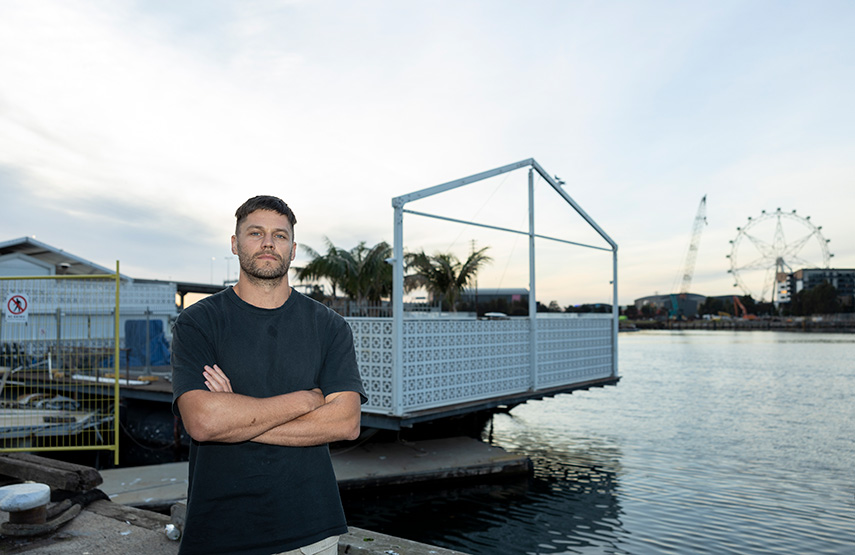
When queried about the day six events, Mr Hughes told CBD News, “they couldn’t let her take the stand, because then the truth would have been exposed.”
But once the City tried to wind back the breadth of that admission on day seven, the plaintiffs immediately said Ms Leighton would be required to give evidence on the live issues that remained. The council accepted that was “the appropriate course”. The case is now due for another directions hearing with the major question as to whether Ms Leighton will be required to take the stand still lingering.
That is a remarkable turn of events. It suggests a council that wanted the benefit of conceding enough to stop the liability fight, while still preserving room to cut down the damages case later. Instead, it ended up reopening the very evidentiary problem it appeared to be trying to avoid.
The broader evidence in the case has only sharpened those questions.
Former Invest Melbourne chief executive Peter Armstrong, whose agency had helped facilitate the ATET project, told the court that when it was put to him that Ms Leighton would say she encouraged multiple parties to deal directly with Mr Hughes, his response was: “that’s a blatant lie.” In re-examination he went further, saying: “because they tried to choke it down. We were excluded.” He also gave evidence that discussion led by Ms Leighton at one meeting was “around the steps to work towards a breach notice being issued to ATET.”
Those are serious claims. They do not, on their own, prove wrongdoing. But they do go to the larger question of how the City’s internal processes shifted from facilitation and problem-solving to enforcement and shutdown.
The council’s own public response so far has leaned heavily on complaints. It has said it did not take the issue lightly, that ATET generated a record number of complaints, and that it worked extensively with the operator to find solutions. That is part of the story. The trial evidence from council planning officer Julian Edwards certainly supports the proposition that complaint numbers were unusually high at the start. He described at least 130 complaints after opening weekend as “off the charts”.
But the case is now plainly about far more than complaints.
The real issue is whether the council unlawfully shut down a business that it had once publicly championed and that, on the evidence aired so far, had continued to put forward options including noise attenuation, relocation and structural changes. If that is where this ends up, then the question ceases to be whether ATET was controversial. The question becomes why the council chose a path that has now led to admitted liability, wasted court time, and a growing exposure that ratepayers will ultimately have to fund.
This is what makes the ATET case more than a dispute about a floating nightclub. It goes to whether the public can have confidence in the way decisions are made at Town Hall, especially when political heat is high and pressure is coming from all sides. Councils are expected to exercise power lawfully, fairly and carefully. They are also expected, once they are clearly in trouble, not to compound the damage.
On that measure, this case is becoming harder and harder for the City of Melbourne to explain away.
The longer it drags on, the higher the legal bill climbs. The more the legal bill climbs, the harder it becomes to avoid the final question. Not just what went wrong, but who, exactly, will wear it. •
Buy our Journalists a coffee
Support our dedicated journalists with a donation to help us continue delivering high-quality, reliable news


Related Articles
Council backs AI push, framing moment as Melbourne’s “fork in the road”
The City of Melbourne has backed a new push to prepare the city for the workforce disruption and economic opportunities created by generative AI, after councillors supported a motion from Cr Andrew Rowse at the Future Melbourne Committee on May 5.
Read More
CBD budget doubles down on safety, support and a more walkable city
The City of Melbourne’s latest budget makes clear that, for the CBD, safety and street-level confidence remain the council’s central political and civic priority.
Read More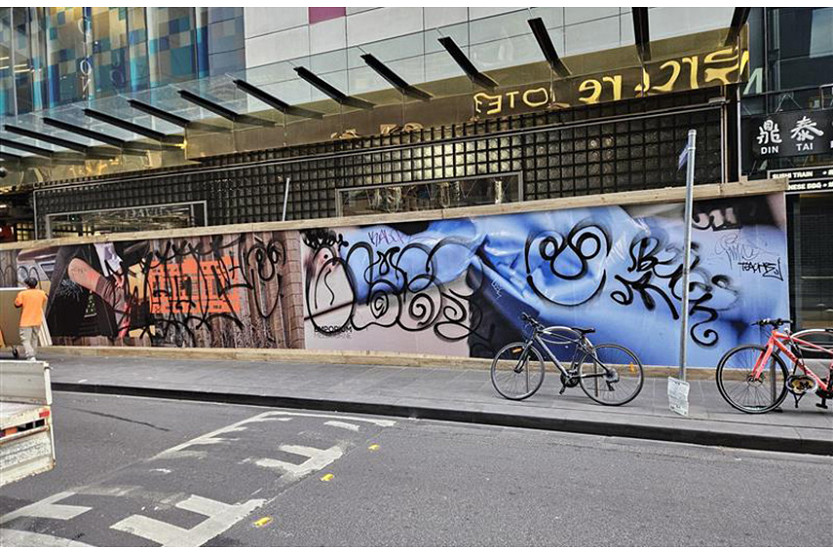
Council moves to make graffiti vandals pay
The City of Melbourne is stepping up its crackdown on graffiti, with councillors set to back compensation orders against taggers being prosecuted by Victoria Police in what the council says is the next step in its “You Spray, You Pay” policy.
Read More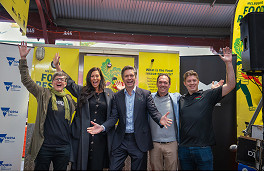
QVM food rescue program turns surplus produce into relief for struggling Melburnians
Council backs AI push, framing moment as Melbourne’s “fork in the road”

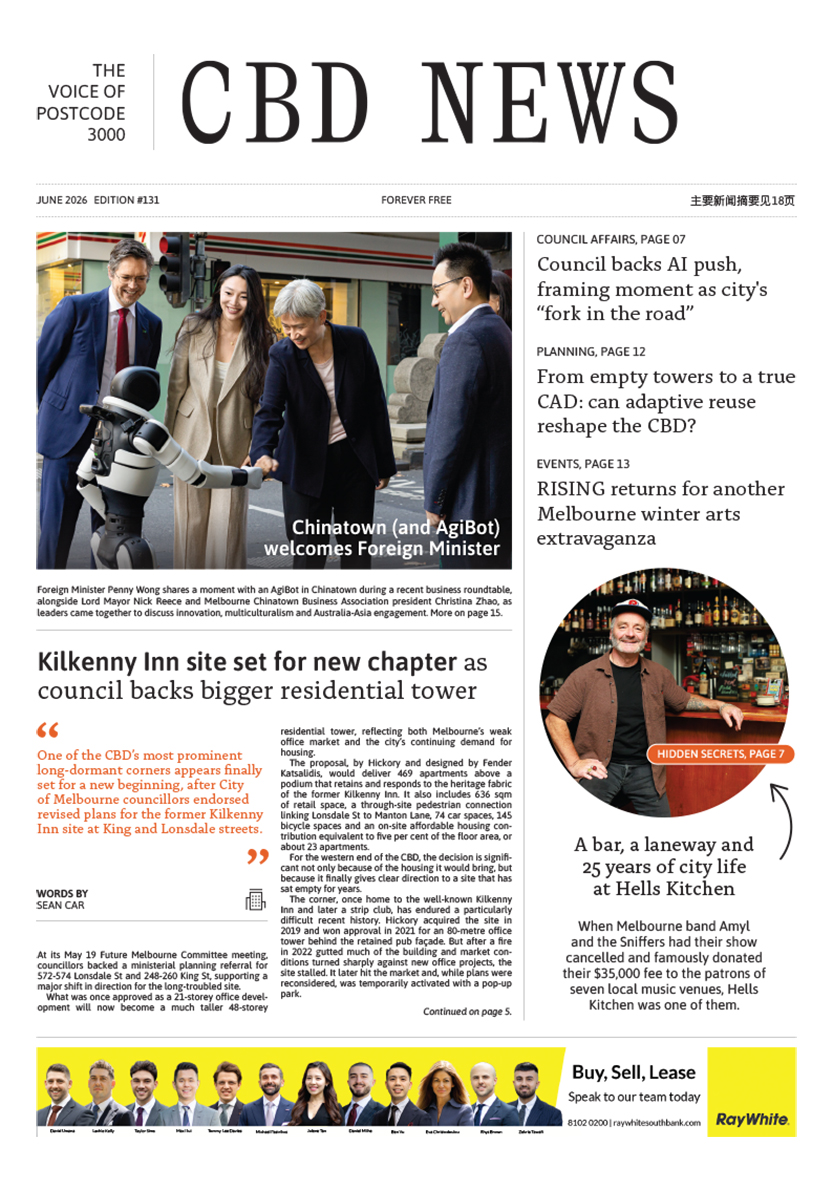 Download the Latest Edition