
Council calls for stronger action on extremism following violent city protests
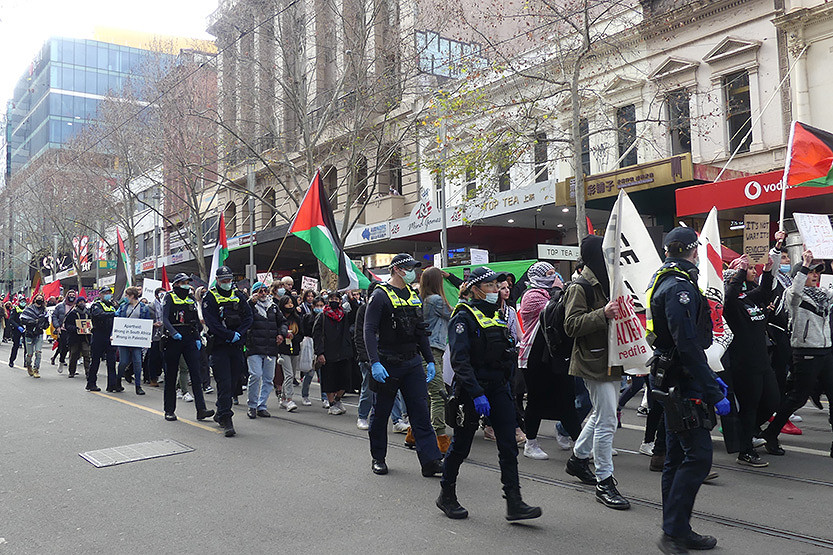
The City of Melbourne has unanimously backed a motion calling on the Victorian Government to fast-track the implementation of recommendations from the state’s 2022 Inquiry into Extremism, amid growing concern over violent demonstrations in the CBD.
The motion, moved by Cr Dr Olivia Ball and seconded by Cr Philip Le Liu, was passed at the Future Melbourne Committee meeting on October 21 following a spate of extremist activity in the city – including a violent anti-immigration protest on August 31 and an attack by self-described neo-Nazis on a First Nations assembly at Camp Sovereignty in Kings Domain on the same day.
The committee’s vote reaffirmed the council’s condemnation of all forms of violence, intimidation and racism and urged state authorities to “redouble” efforts to curb the rise of extremist ideologies.
“This motion seeks to call on the state government to redouble its efforts to implement the recommendations of its own inquiry, and for us at local government to think about our role – what we can do to build social cohesion and lessen the risks and vulnerabilities to radicalisation of any type,” Cr Dr Ball said.
The 2022 parliamentary inquiry, which was the first of its kind in Australia, found that extremism was not simply a law enforcement issue but a “whole of society” challenge that required governments, communities and institutions to work together to build social cohesion and strengthen democratic values.
According to Cr Dr Ball, the government had only fully implemented two of the inquiry’s 12 recommendations – despite accepting most either “in principle” or in full. Those implemented include the banning of the Nazi salute and the passage of the Anti-Vilification Bill 2025, while other recommendations, such as supporting community-based prevention programs and strengthening education, remain unfulfilled.
The council’s motion specifically calls for the Lord Mayor and CEO to write to the Premier and Attorney-General urging them to prioritise the completion of all recommendations, and for management to develop evidence-based local actions to support social cohesion and anti-racism education.
Cr Dr Ball said that young people were particularly vulnerable to extremist narratives, especially those facing social isolation or disadvantage.
“Youth workers and social workers have a vital role to play, and this is a realm where local government can be active in engaging with our youth workforce to design risk mitigation strategies,” she said.
The motion also highlights the role that councils can play through community-led initiatives, anti-racism campaigns, and deliberative democracy programs that build trust in civic institutions – echoing the inquiry’s recommendations for stronger local collaboration with schools, libraries and community organisations.
The motion was supported by testimony from community advocate Milo Parker, who was among those targeted during the attack at Camp Sovereignty earlier this year.
“This happened a kilometre away from where we are right now,” Mr Parker told councillors. “It’s important to recognise that this extreme behaviour isn’t just happening overseas or in other states – it’s happening here.”
While all councillors supported the motion, several emphasised that extremism was not confined to any single ideology or group.

“It’s not actually one side – it’s both sides,” said Cr Le Liu, who seconded the motion.
“Anything called extremism happens on both ends,” added Cr Gladys Liu, while Cr Rafael Camillo noted that “whether from the right or the left, extremism is never justified.”
The discussion underscored concerns that radicalisation can emerge from a wide range of sources – from online echo chambers and misinformation to economic hardship and social alienation – with experts warning that hate-fuelled movements have become increasingly visible in public spaces since the pandemic.
Cr Dr Ball said the council’s role would focus on fostering inclusion and resilience through programs that “build community and trust in civic institutions”.
“We know how to do this,” she said. “The council already has strong partnerships with community organisations and multicultural networks that can be strengthened to counter division and fear.”
The motion passed without opposition, making Melbourne one of the first local governments in Victoria to formally endorse the state inquiry’s recommendations and call for their complete implementation.
While no specific initiatives have yet been outlined, council officers have been tasked with preparing a report outlining possible next steps, including education programs, youth engagement strategies, and collaborations with multicultural groups. •
Buy our Journalists a coffee
Support our dedicated journalists with a donation to help us continue delivering high-quality, reliable news


Related Articles

Council backs AI push, framing moment as Melbourne’s “fork in the road”
The City of Melbourne has backed a new push to prepare the city for the workforce disruption and economic opportunities created by generative AI, after councillors supported a motion from Cr Andrew Rowse at the Future Melbourne Committee on May 5.
Read More
ATET legal mess lays bare major questions for the City of Melbourne
The $7 million Supreme Court fight over Docklands floating events space ATET has now reached the point where the City of Melbourne can no longer plausibly present it as just another difficult regulatory dispute.
Read More
CBD budget doubles down on safety, support and a more walkable city
The City of Melbourne’s latest budget makes clear that, for the CBD, safety and street-level confidence remain the council’s central political and civic priority.
Read More
Kilkenny Inn site set for new chapter as council backs bigger residential tower
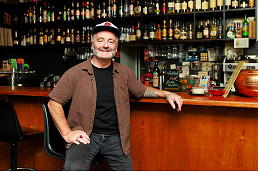
A bar, a laneway and 25 years of city life at Hells Kitchen

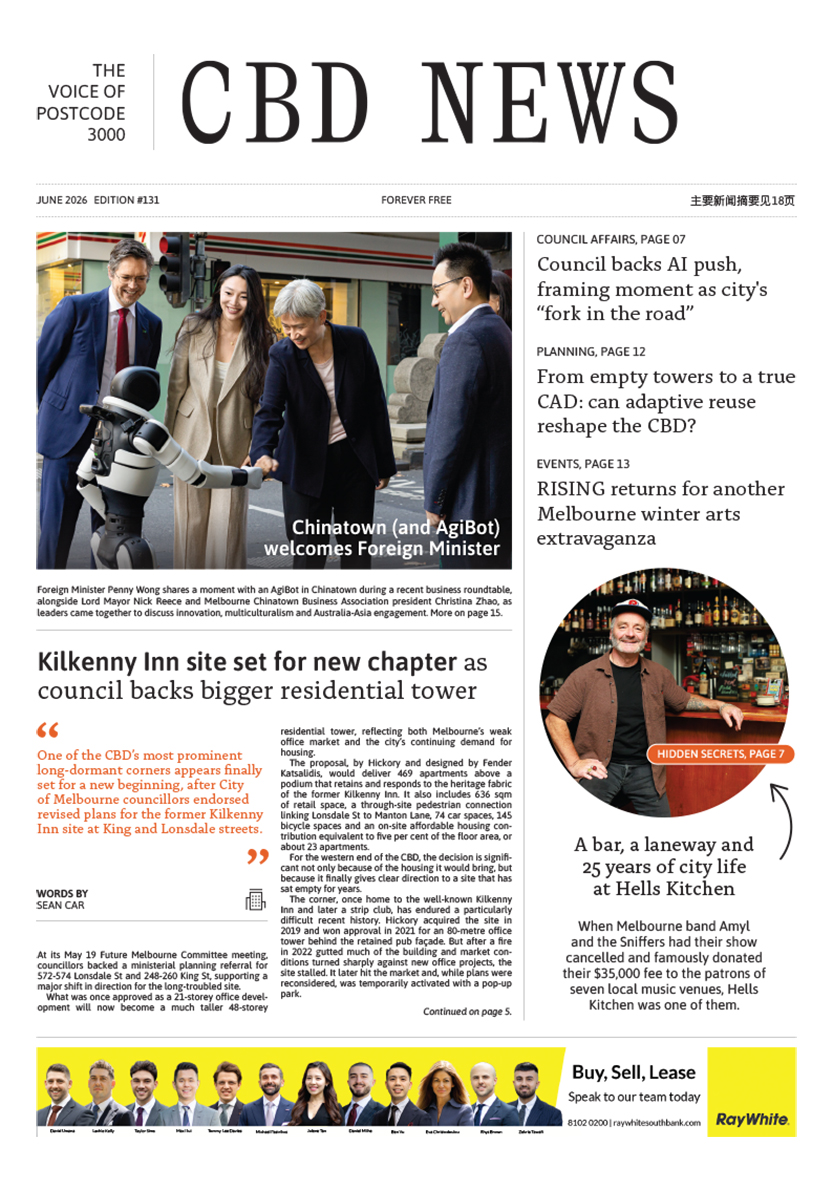 Download the Latest Edition