
Five councillors forced to exit Comedy Theatre tower debate over donation conflicts
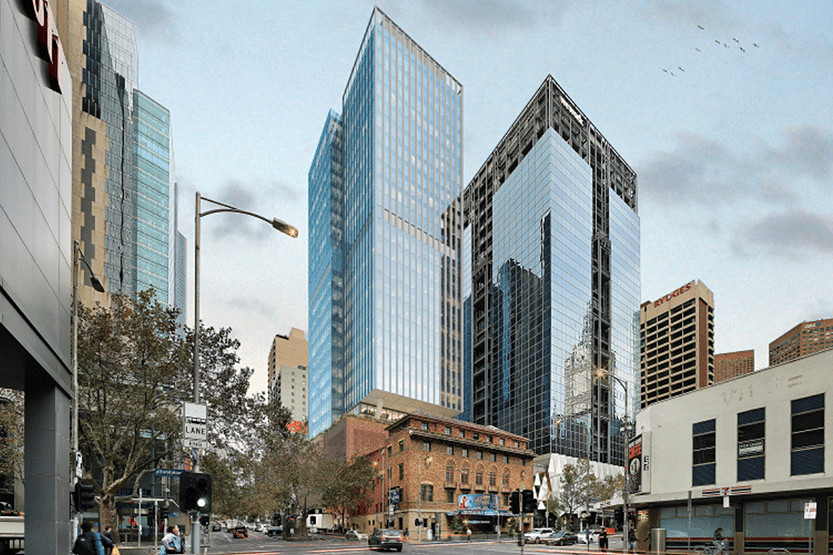

Five City of Melbourne councillors were forced to leave the chamber ahead of deliberations on a major redevelopment above the Comedy Theatre after declaring campaign donation conflicts.
The mass exodus at the December 2 Future Melbourne Committee meeting left a pared-back group of six – just enough to achieve a quorum – to form the council’s position on the contentious proposal.
The application for 222 and 240 Exhibition St seeks approval for a 27-storey mixed-use tower comprising a 270-room hotel, nine levels of office space, basement upgrades, and extensive back-of-house works to the state-heritage-listed Comedy Theatre.
The joint application, lodged by LaSalle Investment Management with involvement from Marriner Group (The Comedy Theatre Pty Ltd) as the owner of 240 Exhibition St, has undergone several design revisions since 2022 and sits at the sensitive interface between the Bourke Hill precinct and the high-rise spine of Lonsdale St.
Before the matter could be heard, Cr Phil Le Liu – who ran with Team Arron Wood in last year’s election – declared a conflict of interest having received a campaign donation from the Marriner Group. He was then joined by Lord Mayor Nick Reece, Deputy Lord Mayor Roshena Campbell, Cr Mark Scott and Cr Kevin Louey, all members of Team Reece, which also accepted a Marriner Group donation last year.
With the departures removing five councillors from one of the term’s most high-profile planning items, Cr Campbell relinquished the chair and environment portfolio chair Cr Davydd Griffiths was nominated to preside, leaving six councillors – Griffiths, Rafael Camillo, Olivia Ball, Gladys Liu, Owen Guest and Andrew Rowse – to determine the council’s response to Planning Minister Sonya Kilkenny.
Officers recommended that councillors “not object” to the proposal, subject to substantial changes including increased tower setbacks, improved laneway activation, and resolution of the interface between the tower and the heritage-listed fly tower.
Residents used the opportunity to highlight broader concerns about planning governance, consultation and heritage protections.

The proposal looking from Lonsdale St towards Punch Lane.
Punch Lane resident Jenny Eltham delivered a passionate address criticising planning systems that leave communities “voiceless and sidelined”, adding that dense documentation and technical codes obscured real-world impacts such as loss of sunlight, early-morning construction noise and declining residential amenity.
She argued that planning had become “a stealthy David and Goliath exercise” where residents “are treated as obstacles rather than stakeholders”.
Fellow resident Nicola Smith, who lives in the Bourke Hill precinct, said the tower “completely dominates” the Comedy Theatre and undermined the fine-grain character protected by design controls.
She disputed claims of only “minor” shadow impacts and argued the proposed height and setbacks didn’t comply with the planning scheme.
Their concerns mirrored formal objections lodged by EastEnders president Dr Stan Capp and the National Trust.
Dr Capp raised “natural justice” concerns about the lack of notice and argued the scheme would “severely reduce” the Comedy Theatre’s heritage integrity. The National Trust warned the tower’s “overwhelming scale” threatened the historic theatre district’s cultural significance.
Urbis consultant Jamie Govenlock, speaking on behalf of the applicant, told councillors the proposal was the result of years of negotiation between multiple landowners, Heritage Victoria and state planners, and said the project would deliver “much-needed” improvements to the Comedy Theatre’s back-of-house operations.
He said the site’s servicing, waste, loading and access arrangements had been designed to function internally within the car park – rather than from the street – to reduce impacts on residents in Punch Lane.
Mr Govenlock also argued that Melbourne “is losing shows to Sydney” because competing theatres have modernised while the Comedy Theatre has not, and said the upgrades were essential to keeping the venue competitive.
No meaningful improvements have occurred to the theatre since it was built in 1928,” he said. “So, this this will be one of the first major refurbs of its time. The proposal also activates Punch Lane and Lonsdale streets.
One of the central technical issues discussed was the use of the combined titles of 222 and 240 Exhibition St to shape the floor area ratio (FAR). With the air rights to the Comedy Theatre land included in the calculation, the FAR sits at 14.25:1 – comfortably within the city’s 18:1 benchmark – even though nothing can realistically be built above the heritage-listed building.
Cr Andrew Rowse said, “Using heritage buildings in the calculation of floor area ratio, in my view, doesn't pass the pub test, but the pub test is not what we're needing to pass today.”
Officers emphasised that FAR and built-form controls were separate and that the key compliance test were in meeting height and setback requirements under the relevant overlays.
Council officers maintained that, subject to design refinements, the proposal was capable of support. They also advised councillors against deferring the matter, warning that the Minister was preparing to make a decision, and a delay could result in the city losing its opportunity to provide formal comment.
Cr Rafael Camillo, who also serves as president of Residents 3000, moved an alternative motion that adopted the officer recommendation with additional conditions aimed at protecting residential amenity.
His amendments required a detailed hotel management plan addressing operations, safety and complaint handling, a site plan covering loading and servicing impacts, and acoustic controls ensuring residents would not be exposed to audible noise from air-conditioning or mechanical systems during designated hours.
Cr Camillo said he understood the concerns raised by residents but emphasised that the application had followed the state-led process and needed to be assessed within that framework.
Cr Dr Ball highlighted that Heritage Victoria would separately assess works affecting the Comedy Theatre itself, while Cr Guest thanked submitters and acknowledged the need for improved engagement practices. Cr Rowse reaffirmed his discomfort with the FAR implications but supported the officers’ approach.
The alternative motion was carried unanimously among the six councillors present. Once the conflicted councillors returned to the chamber, the meeting proceeded to the next item.
The council’s position will now be forwarded to Planning Minister Sonya Kilkenny for final determination, which is still subject to approval from Heritage Victoria as the responsible authority for heritage works at Comedy Theatre.
Buy our Journalists a coffee
Support our dedicated journalists with a donation to help us continue delivering high-quality, reliable news


Related Articles
The rise of the “third room”: How Australians are reinventing their outdoor spaces
There was a time when the backyard was an afterthought. A patch of grass, a rusting barbecue, maybe a plastic chair or two.
Read More
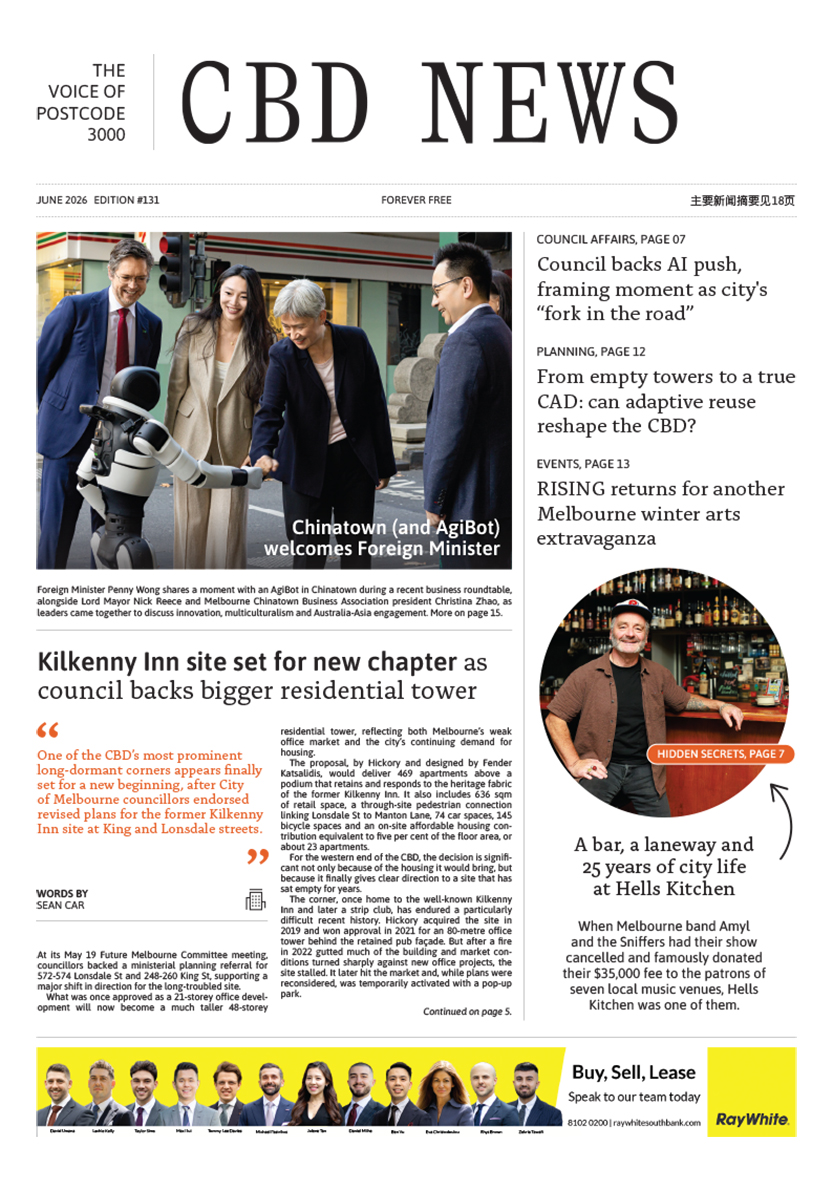
Kilkenny Inn site set for new chapter as council backs bigger residential tower
One of the CBD’s most prominent long-dormant corners appears finally set for a new beginning, after City of Melbourne councillors endorsed revised plans for the former Kilkenny Inn site at King and Lonsdale streets.
Read More
From empty towers to a true CAD: can adaptive reuse reshape the CBD?
As the state government reviews long-criticised CBD developer incentives, a powerful new data tool from Plus Studio could help reveal which underused towers are ready to shift Melbourne from a Central Business District to a true Central Activity District (CAD).
Read More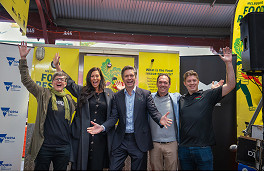
QVM food rescue program turns surplus produce into relief for struggling Melburnians
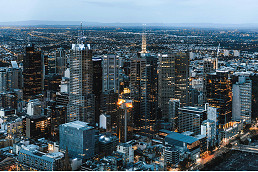
Council backs AI push, framing moment as Melbourne’s “fork in the road”

 Download the Latest Edition