
“Ghost colleges”: a reflection of Australia’s relationship with migrant work
Melbourne is home to more than 230,000 international students from around 175 different countries. It is an international hub of innovation, artistry and community that makes it a drawcard for so many.
However, outside of the major universities, there are a significant number of vocational skills providers many of whose sole purposes appear to be to exploit the current student visa loophole in Australia.
In Melbourne’s CBD alone there are more than 50 colleges, institutions or academies that operate just out of plain view, in buildings you never frequent and in classrooms that are empty.
These are what are known as “ghost colleges” – spaces that present as legitimate vocational institutions, yet their cohort is all online, attendance is rarely checked, and the bulk of their studies are taught via Word documents.
They are found across all major cities in Australia, and their prominence marks a far more sinister reflection of Australia’s relationship with migrant work.
The number of international student enrolments in vocational education programs rose from 116,651 in 2016 to 262,955 in 2025.
These providers offer a range of accreditations such as diplomas and certificates and all cost in the range of thousands. The Commonwealth Register of Institutions and
Courses for Overseas Students cites 573 institutions operating in Victoria alone.
Yet the value of these accreditations and their place in Australian society are brought into question.
Dr Salvatore Babones, Associate Professor in sociology and criminology at the University of Sydney, explained the exploitative relationship between these vocational providers and migrant work.
If there was value in these types of degrees and these education providers, we would see a larger number of students from relatively rich non-English speaking countries. Large numbers of Japanese, Korean, Middle Eastern, Thai. But we don’t, Dr Babones said.
“The overwhelming flow of students are from some of the poorest countries in the world.”
He added that as a nation we “have the pretence that Australia doesn’t do a guest-worker economy. Yet in effect that’s what Australia does.”
This reflection of Australia’s relationship with migrant work is stark. Dr Babones argues that the pretence of the system we have creates multiple financial hurdles purely for someone to be able to access Australia’s labour market.
Conversely, Singapore operates a guest-worker system with a roughly 1.5 million migrant workers all successfully allowed to access the labour market through a visa process.
Access to the labour market under the Australian system is slightly different. First, one must apply as a student to a vocational education provider, normally through an “education agent” receiving commission ranging from 30 to 40 per cent of the student’s tuition fees, then apply for the appropriate student visa ($2000) then enrol at the vocational institute (courses range from $3000 to $35,000).
“It’s highly exploitative. It puts all the risk on the poor person, and the poor person has to pay for a degree they’re never going to use and usually a succession of degrees, just so they are able to access the labour market,” Dr Babones said.
The revenue for vocational institutions in Australia was $13.3bn in 2025.
With these hurdles and cost for entry and work in Australia, many international students and migrants feel unsupported and unheard, with social services having to pick up the slack left by successive government inaction.
The Couch, a program run by The Salvation Army, offers international students “an opportunity to connect with support services and information on a range of issues including housing, employment, counselling, student services, legal support and representation”.
The Couch has been running since 2013 and “provides a safe space for international students to create meaningful connections with each other and the city around them,” according to the program’s coordinator Elle Phan.
Since COVID, she said that “international students have been struggling, with minimal support from the government.”
“We want to create a community that supports these students to achieve their potential in Australia,” Ms Phan said.
Major Brendan Nottle from The Salvation Army discussed the issue as well highlighting the “obligation” felt by social services.
“We feel an obligation to provide support to not just that particular affected group of people but any international student that is looking for an opportunity for connection,” Major Nottle said.
“We leave that to the regulators to deal with, however as a result of some of that behaviour we do see the victims of it present at places like The Salvation Army at Bourke St.”
The City of Melbourne provides support through such initiatives as the Study Melbourne Hub and the Lord Mayor’s student welcome, which provides international students with access to student services, advice and support. This distinctly highlights the impact of the current international student system on local and social services.
The council’s innovation and education portfolio lead Cr Andrew Rowse reiterated its support for international students “through programs and services”, “while the regulation of vocational institutes sits within state and federal jurisdictions”.
“The City of Melbourne is focused on ensuring all our international visitors, especially students, have the best and safest experience in the city,” Cr Rowse said.
The federal government has “cracked down” on ghost colleges since 2020, with current Minister for Skills and Training Andrew Giles MP “calling time on these dodgy providers”.
In August 2024, Minister Giles said that the government had “weeded out and shut down over 150 dormant operators” issuing warnings to “140 others”.
However, it’s inherently difficult for government regulators to ascertain what colleges are legitimate due to some institutions falsifying student records and attendance, with “around 3800 registered training organisations in Australia”.
The Australian Skills Quality Authority (ASQA) is the main regulatory body that oversees vocational education and training (VET) providers. Since October 2023 it has established a “Tip-Off” line for “illicit or unethical activities within the sector” and has received “more than 3200 tip-offs with around 60 per cent of information leading to actionable intelligence”.
But Dr Babones isn’t hopeful that we will see effective and long-lasting change.
“It’s very pleasant for the professional class. I can get cheap food delivery; I can get cheap rides everywhere. I can get cheap services. It benefits the well-off in society.”
Minister Giles was contacted for comment, but his office referred the matter to the Australian Skills Quality Authority. It did not respond to CBD News before deadline.
Major Nottle believes that as a community, “we all have a responsibility to build a safety net at the top of the cliff”.
“[That’s] far better than parking an ambulance or worse, a hearse, at the bottom.” •
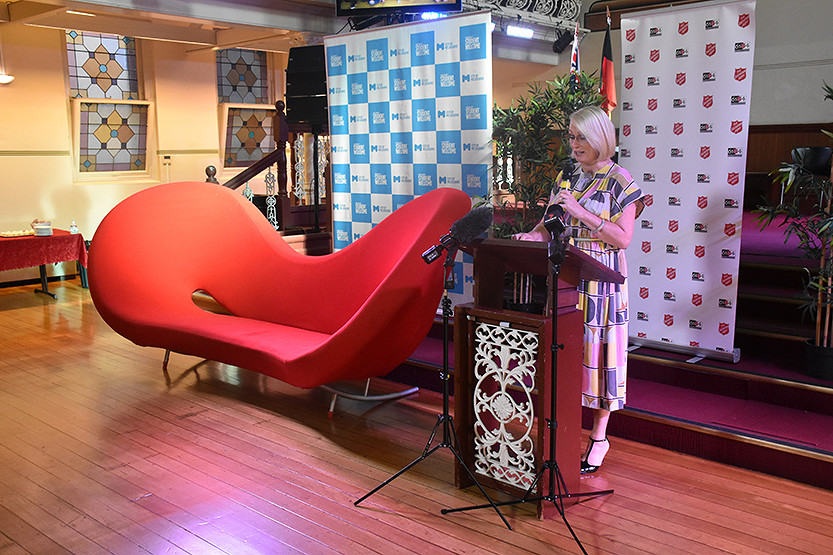
Photo: Former Lord Mayor Sally Capp launches the return of The Couch program at The Salvation Army in 2021.
Buy our Journalists a coffee
Support our dedicated journalists with a donation to help us continue delivering high-quality, reliable news


Related Articles
Mekong owner’s scholarship fund marks 20 years and opens 2026 applications
A Swanston St restaurant owner who arrived in Australia with little more than determination has spent the past two decades quietly building one of Melbourne’s most enduring scholarship programs.
Read More
Australia tightens the screws on international students
One in three international students applying to an Australian university was rejected in February 2026. That 32.5 per cent refusal rate is the highest monthly figure recorded in 21 years of tracking data, and it is no accident.
Read More
New CBD training hub opens for migrants and refugees at Flinders St
A new migrant education and training site has opened in Melbourne’s CBD, with AMES Australia launching a larger city-base designed to help more people from refugee and migrant backgrounds build skills, confidence and pathways into work.
Read More
QVM food rescue program turns surplus produce into relief for struggling Melburnians

Council backs AI push, framing moment as Melbourne’s “fork in the road”

 Download the Latest Edition