
Lord Mayor calls for urgent overhaul of developer bonuses as $495m Queen St tower wins council backing


A $495 million mixed-use tower overlooking Queen Victoria Market has won unanimous backing at Town Hall, but only after Lord Mayor Nick Reece used the decision to call for an urgent overhaul of Melbourne’s developer “bonus” system for office space.
Councillors voted on December 2 to advise Planning Minister Sonya Kilkenny that the City of Melbourne “does not object” to the 67-storey development at 400 Queen St, subject to a suite of conditions and a major rethink of the public benefits tied to its bonus floor area.
The proposal by Sime Darby Property would replace a seven-storey commercial car park with a 220.4-metre tower containing 693 build-to-sell apartments, 640 student housing units with 900 beds, 10,103 square metres of office space and 3419 square metres of retail.
The prominent corner site spans Queen and A’Beckett streets, with narrow links to Anthony St, and sits immediately south of the Queen Victoria Market (QVM). Council officers described the project as a “significant mixed-use building” that would make “a positive contribution to the skyline” and provide a strong transition between the market precinct and the central city.
However, a point of contention was not the tower’s height or mix of uses, but how the developer proposed to justify its hefty floor area uplift under the central city’s incentive scheme.
The project seeks a floor area ratio of 28.62:1 – well above the as-of-right 18:1 – translating to 34,166 square metres of bonus floor area valued at about $34.2 million.
To secure that uplift, the developer put forward a public benefit package worth a claimed $48.8 million, including:
- $25.26 million in “strategic use – office” uplift for the 10,103 square metres of office space, and
- $23.55 million in “laneway credit” for 1314 square metres of publicly accessible open space and arcades running through the site.
But council planners flatly rejected the idea that office space and internal laneways, as proposed, constituted an acceptable public benefit in 2025.
Officers said the reliance on office as a strategically justified use “is not compatible with contemporary strategic planning imperatives”, noting that the uplift guidelines dating back to 2016 and had “not been reviewed or updated in the intervening period”.

They also found the laneways “ambiguous in their role and function as a public benefit”, pointing out that they primarily serve as access to internal areas, lack clear connections to key pedestrian routes and include narrow links to Anthony St that raise “safety and entrapment risks”. One of these connections is recommended to be removed altogether.
In a pointed contribution, Cr Reece said the case laid bare the flaws of the current uplift regime, which has long been criticised for channelling bonuses into office floorspace rather than community infrastructure or affordable housing.
“I do think that this project does illustrate some of the fact that the development uplift arrangements in Melbourne are now out of date, and are urgently in need of reform,” he told the meeting.
They were set up over eight years ago. Melbourne has changed very significantly since then. I’m not aware of anyone out there saying Melbourne desperately needs more office space.
“The fact that on the submission before us, there’s a $25 million uplift there for office being part of the development, I don’t think that passes the pub test.”
While he said it was “totally reasonable” for the project to include a mix of uses, the Lord Mayor argued that counting office as public benefit came with a steep price.
“You’ve got to ask yourself, what’s the opportunity cost there? And the opportunity cost is less affordable housing, which Melbourne desperately needs. The opportunity cost is less green space, which Melbourne could really use in a really densely populated part of the city. Less public art, which is always a great thing in a growing, bustling city like ours.”
“My remarks are not in any way directed at this particular development application,” he added. “My remarks are directed at the overall planning scheme that we’re now operating in … and I think this application illustrates the need for us to really update those development uplift arrangements and make sure that they’re fit for purpose for Melbourne in 2025.”
The comments echo long-running concerns that the voluntary uplift system has failed to deliver affordable housing, despite approving tens of thousands of new dwellings across the CBD and Southbank, while allowing developers to claim extra floor area in exchange for office space and semi-public private realms.
The council’s recommendation to the Minister insists that any uplift at 400 Queen St be tied to “public benefits which are commensurate to the Floor Area Uplift above 18:1” and include “a meaningful component of affordable housing”.
Further conditions seek to tighten the laneway design, restrict public access to the narrow northern easement due to safety concerns, and ensure the more generous pedestrian connections are genuinely open and legible 24 hours a day.
Apartment quality and density were also in the spotlight. The tower proposes 693 dwellings – mostly studios and one-bedroom apartments – plus 640 student units, many of them compact.
Cr Andrew Rowse questioned whether some of the smaller studios, particularly those earmarked for students, met community expectations. He told the meeting that many were “not much bigger than a juvenile detention centre cell”, asking, “Is that what we want to be doing as a society?”
Deputy Lord Mayor Roshena Campbell did praise the number of build-to-sell apartments having been recently critical of the lack of off-the-plan apartment projects being proposed for Melbourne.
Officers recommended changes to improve internal amenity, including more communal space for student housing, better solar access for south-facing apartments, and a requirement to introduce three-bedroom dwellings into the mix.
The developer also committed to working with the state government to include a provision of affordable housing as part of ongoing efforts to resolve the project’s public benefit contribution.
Despite the misgivings, councillors ultimately backed the recommendation to support the project in principle, with QVM trader Cr Mark Scott abstaining.
Buy our Journalists a coffee
Support our dedicated journalists with a donation to help us continue delivering high-quality, reliable news


Related Articles
Hosier Lane back in action following accessibility upgrades
Upgrade works have been completed at Hosier Lane, improving accessibility and pedestrian movement through one of Melbourne’s best-known street art destinations.
Read More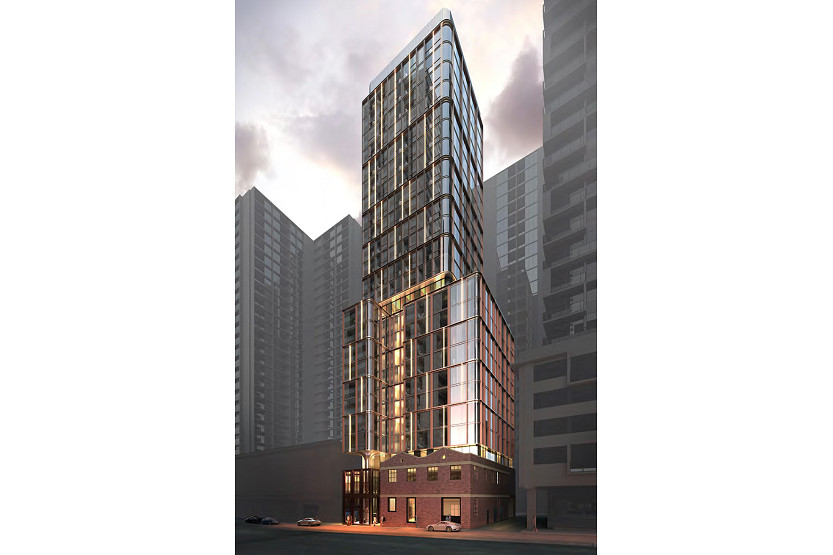
Little Bourke St hotel changes backed
A long-approved hotel development on Little Bourke St is a step closer to construction after City of Melbourne councillors unanimously backed amendments to the planning permit at their July 21 Future Melbourne Committee meeting.
Read More
Council backs Retrofit Melbourne pilot
The City of Melbourne has approved a new three-year Retrofit Melbourne Financial Incentive Scheme, aimed at helping older commercial buildings cut emissions, reduce operating costs and remain competitive amid high office vacancy rates.
Read More
Who actually pays Victorians the most for solar

EastEnders to host Lord Mayor and Deputy Lord Mayor

 Download the Latest Edition