
A vaulted history beneath the railway
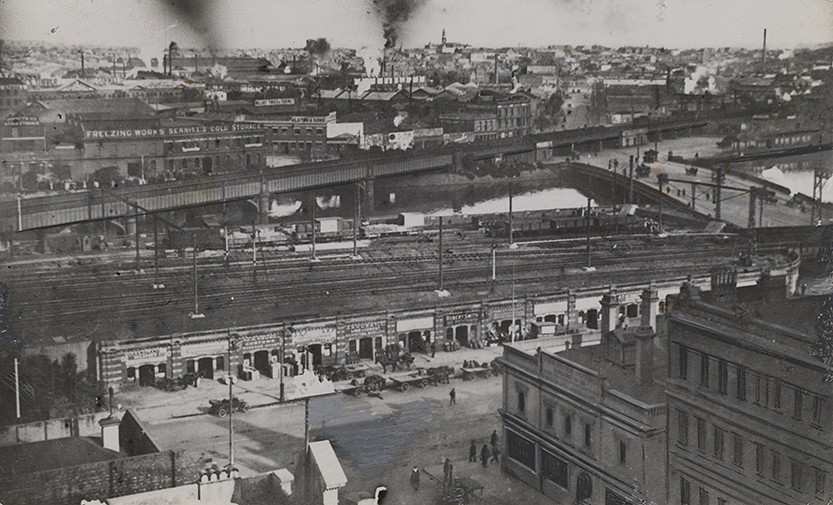
In this photograph, taken around the 1910s in Flinders St near the Queens Bridge (on the right), is the railway line into Flinders Street Station. Back then, the area was at the height of its activity.
Trains would deliver cargo and passengers from Princes Pier and across the Sandridge Bridge as it cut diagonally across the river. The south side of the Yarra was filled with factories, including Sennitt’s ice works (pictured on the upper left-hand side), a popular ice-cream brand which ran its factory near the Yarra from the 1890s until the early 1960s.
Along the wharves on either side of the river, ships unloaded valuable commodities such as fish and produce into the eager hands of markets and businesses.
Beneath all of that, you may notice a series of brick and concrete stores underneath the railway. These are the viaduct buildings, or the Banana Alley Vaults.
The first train station was built at Flinders St in 1854, and Spencer Street Station followed in 1859. Neither connected until a ground-level line ran along the Spencer St intersection in 1879.
In 1884, the Railway Construction Act (or “Octopus Act” as it became known) was passed, authorising construction of a permanent link and other railway lines, including a viaduct between Spencer and Flinders streets. Construction of the viaduct started in 1888 and was completed by 1891, allowing trains to unload fresh fish at the new Fish Market at the corner of Spencer and Flinders streets, as well as drop off passengers at Flinders St without disrupting traffic.
Part of the project featured the Banana Alley Vaults, initially known as the Viaduct Buildings. Its first tenants were mentioned in the Sands and McDougall in 1893, which included wine merchants, customs agents, rope manufacturers and (of course) a banana merchant.
The Vaults became “Banana Alley” as the arched-ceiling rooms were used to store bananas for ripening. However, that didn’t stop the usual pests of wharf life, such as vermin and insects, from lurking about and giving customers a nasty surprise.
The Herald (February 18, 1898) reported an incident where a customer at S. J. Lanceter’s fruit store noticed what appeared to be a bad banana in their bunch. Just as the customer reached inside their bag, Lanceter noticed something move and stopped the customer, saving them grief from the four-foot, seven-inch (or close to 140cm) long snake lurking inside!
In the picture you can also see customs agent T.H. Young (367 Flinders St); machinery agents Gardner, Waern and Co (369); Lime, coal and cement agents Akhurst and Co. (371); produce agent C.J. Donovan (373); and Robert Grieves, a mantelpiece manufacturer (377). One other notable merchant was Robert Smith, whose store can be seen in the photo at 375 Flinders Street, his sign proudly proclaiming him to be a “seed potato merchant”. He was among the first of the merchants listed in 1893, purchased his bananas from Queensland (any mention of snakes unmentioned) and continued selling into the early 1930s. By then, The Herald reported the vaults would smell heavily “but not unpleasantly” (22nd March 1930, P.2) of everything from spices to Stockholm tar, but they were about to hit hard times. The depression and the opening of the Spencer Street Bridge (closing off ships to the wharves near the turning basin) made life hard for merchants, with some closing or repurposing their businesses (Grieves’ business in particular carried on as a stove manufacturer, and then as a hardware store until the 1950s).
In later years, the vaults would become storerooms for the Victorian Railways refreshment branch, a distribution point for newspapers for dozens of newsboys, and the Pieteria pie shop where sloshed customers staved off a hangover with a pie. Most famously the hobby shop Hearns Hobbies would occupy one of the buildings during the 1950s before moving to its Flinders St home in the 1960s.
By the 1980s, the vaults were neglected, and an attempt was made by the Cain government to revitalise them with a wine-themed tourism project and an art expedition that featured models of rural Australia, but these would be short lived.
Since then, the vaults have recovered and are currently occupied by a gym, a ferry service and, at Robert’s old store, a night club. •
Buy our Journalists a coffee
Support our dedicated journalists with a donation to help us continue delivering high-quality, reliable news


Related Articles
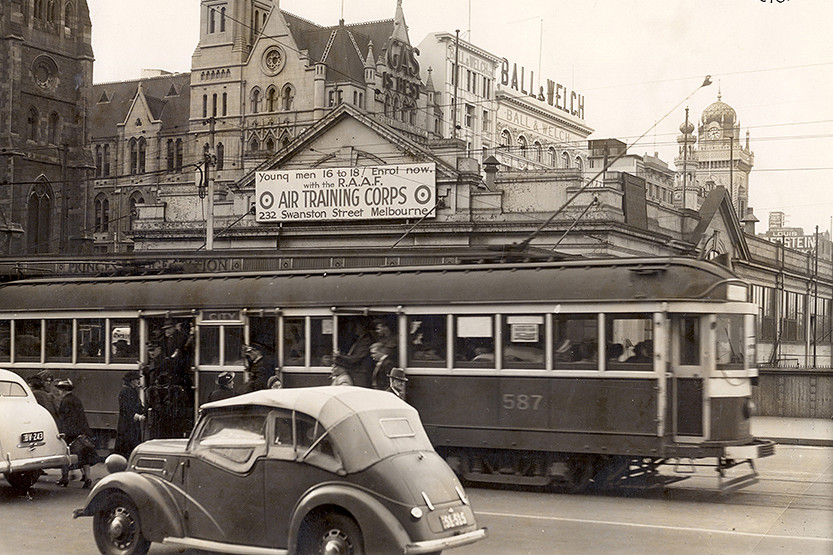
Reminders of wartime looms over Princes Bridge
In the early 1940s in Melbourne, as war ravages overseas, life in the city carries on as normal at the corner of Princes Bridge and Flinders St.
Read More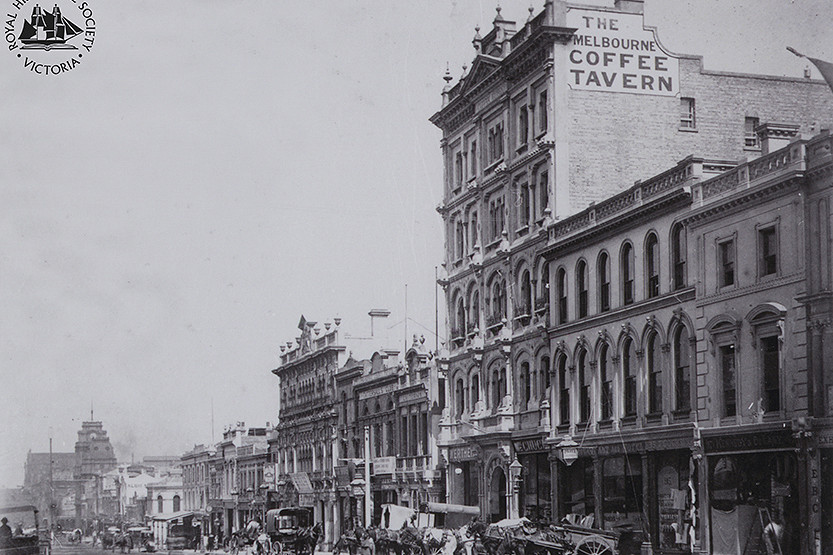
An escapee arrested at the Coffee Tavern
Opened in October 1882 on Bourke St between Swanston and Russell streets, the 90-foot-tall Melbourne Coffee Tavern featured 161 bedrooms and was also home to a sewing machine business owned by Hugo Wertheim.
Read More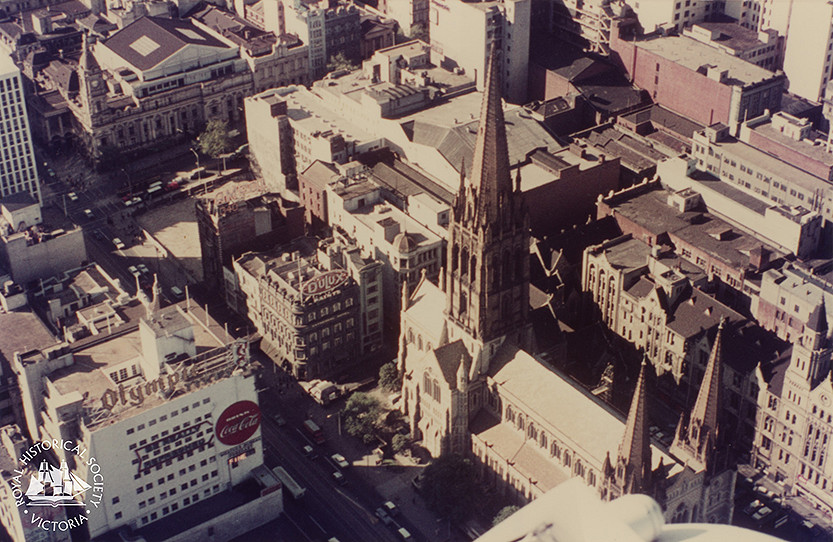
The beginning of a square, and the end of history
For those who are young or new to Melbourne, it might be a shock to discover that buildings once occupied the site of Town Hall Station, at the corner of Swanston and Collins streets.
Read More
QVM food rescue program turns surplus produce into relief for struggling Melburnians
Council backs AI push, framing moment as Melbourne’s “fork in the road”

 Download the Latest Edition