
Council divided as City of Melbourne reverses support for CBD injecting room


A heated and deeply polarising debate erupted at Melbourne Town Hall on November 25 last year as councillors voted to overturn the City of Melbourne’s long-standing support for a medically supervised injecting service (MSIS) in the CBD.
The motion, introduced by Cr Phil Le Liu, formally reversed a position adopted by council in 2021 and reaffirmed in 2022, when councillors backed the Victorian Government’s plans for a second injecting room following an independent expert review. After a lengthy debate, the motion was carried seven to four, marking a significant policy shift and drawing sharp criticism from those who argued the council had abandoned an evidence-based approach to public health.
Cr Le Liu’s motion declared that an injecting room in the City of Melbourne “is not supported in any form due to the potential adverse impact on safety and amenity of businesses, residents and visitors in surrounding areas,” and directed the Lord Mayor and CEO to write to the Premier and Health Minister outlining the council’s revised stance and urging greater investment in drug rehabilitation programs.
Speaking in opposition, Cr Andrew Rowse delivered one of the most forceful speeches of the night, describing the motion as “one of the most embarrassingly least evidenced motions I’ve seen in this chamber.”
“This motion waves away decades of evidence, contradicts our own strategic documents and presents assumptions as facts,” Cr Rowse said, accusing the motion of encouraging “ideological freelancing” and warning the decision undermined commitments in its recently adopted Municipal Public Health and Wellbeing Plan.
Cr Rowse argued that medically supervised injecting services were among the most extensively evaluated health interventions globally, citing findings from coronial inquests, medical colleges and peer-reviewed research showing reduced overdose deaths, ambulance callouts and public injecting, without increases in crime or violence.
“This is not about approving a facility tonight,” he said. “It’s about whether council rules out proven health interventions in advance, without evidence, before any proposal even exists.”
“You cannot logically argue for more access to treatment while rejecting the single most successful gateway into that treatment. That’s like opposing motorcycle helmets but supporting all measures that make motorcycle riders safer. The motion undermines its own stated objective.”
Cr Dr Olivia also opposed the motion, drawing on evaluations of injecting facilities in Kings Cross and North Richmond. She told councillors that independent reviews found no adverse impact on amenity and noted reductions in public injecting and overdoses near schools adjacent to the North Richmond service.
“The City of Melbourne now has the highest rate of fatal opioid overdose in Australia,” Cr Ball said. “That should weigh heavily on us.”
Other councillors, however, argued that community sentiment and lived experience pointed to a different conclusion.
Cr Rafael Camillo said uncertainty and concern among residents and businesses warranted a clear position from the council, adding that he believed efforts should purely be redirected toward rehabilitation and recovery programs.
Cr Roshena Campbell, who ultimately supported the motion, said she had revisited the Hamilton Report into North Richmond’s injecting room and interpreted its findings differently, pointing to community perceptions of safety and police observations of increased drug activity in the surrounding area.
“It would be irresponsible to ignore those concerns,” she said, warning that similar impacts in the CBD could undermine the council’s investment in city safety and cleaning.
Lord Mayor Nick Reece spoke against the motion, describing the issue as complex but saying the evidence overwhelmingly supported supervised injecting services as a life-saving intervention.
“I’ve visited both Kings Cross and North Richmond,” Cr Reece said. “I’ve seen that it is possible to balance medical services with improvements to amenity. These services save lives.”
In his closing remarks, Cr Le Liu rejected claims the motion ignored evidence, arguing that concerns raised by residents and business owners in North Richmond had been discounted for too long.
“We are bravely standing up,” he said. “This is not putting our heads in the sand. This is taking a stand because we love this city.”
The motion’s adoption formally closed the chapter on council support for a CBD injecting room, despite the Victorian Government having already abandoned plans for such a facility due to site challenges.
The government will instead open a new community health hub at 244 Flinders St this year, which will bring together medical care, mental health support, counselling, pharmacy services and social programs under one roof.
The site will also host a Victorian-first hydromorphone treatment trial, designed to reduce harm by diverting people from the illicit drug market and offering evidence-based alternatives for those living with chronic addiction. •
Buy our Journalists a coffee
Support our dedicated journalists with a donation to help us continue delivering high-quality, reliable news


Related Articles

Council backs AI push, framing moment as Melbourne’s “fork in the road”
The City of Melbourne has backed a new push to prepare the city for the workforce disruption and economic opportunities created by generative AI, after councillors supported a motion from Cr Andrew Rowse at the Future Melbourne Committee on May 5.
Read More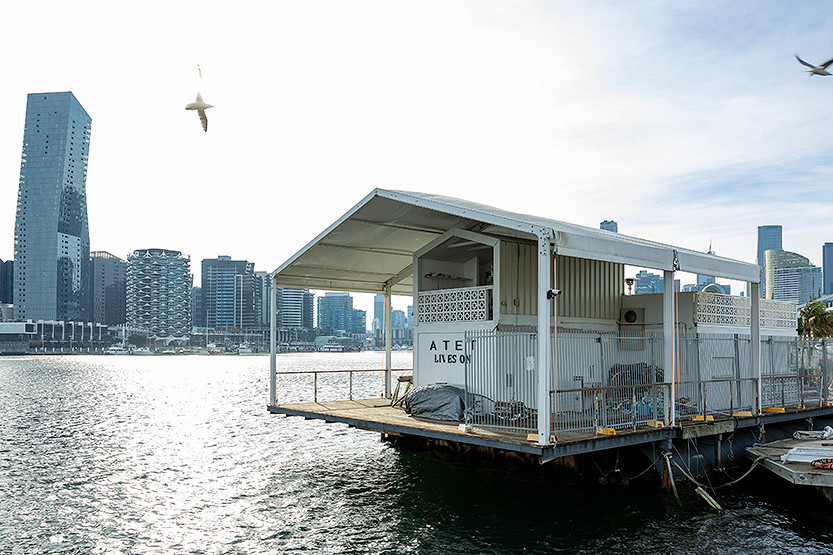
ATET legal mess lays bare major questions for the City of Melbourne
The $7 million Supreme Court fight over Docklands floating events space ATET has now reached the point where the City of Melbourne can no longer plausibly present it as just another difficult regulatory dispute.
Read More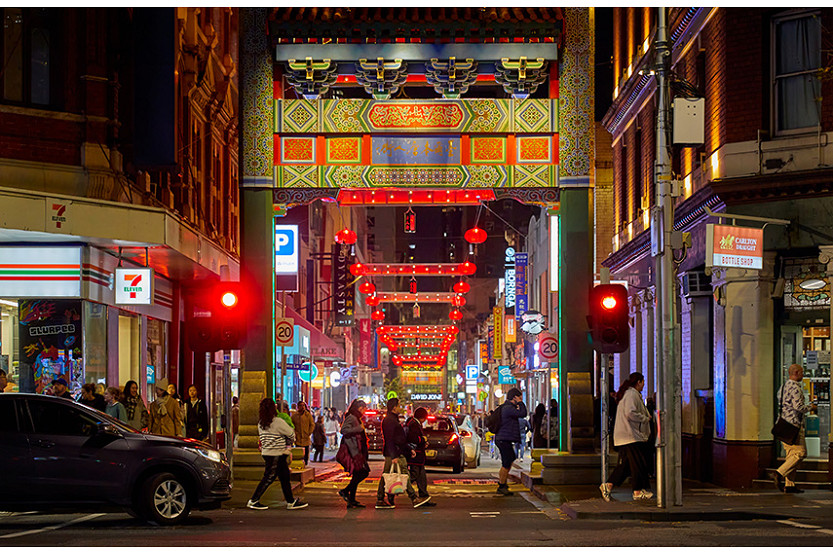
CBD budget doubles down on safety, support and a more walkable city
The City of Melbourne’s latest budget makes clear that, for the CBD, safety and street-level confidence remain the council’s central political and civic priority.
Read More
Council backs AI push, framing moment as Melbourne’s “fork in the road”

Kilkenny Inn site set for new chapter as council backs bigger residential tower

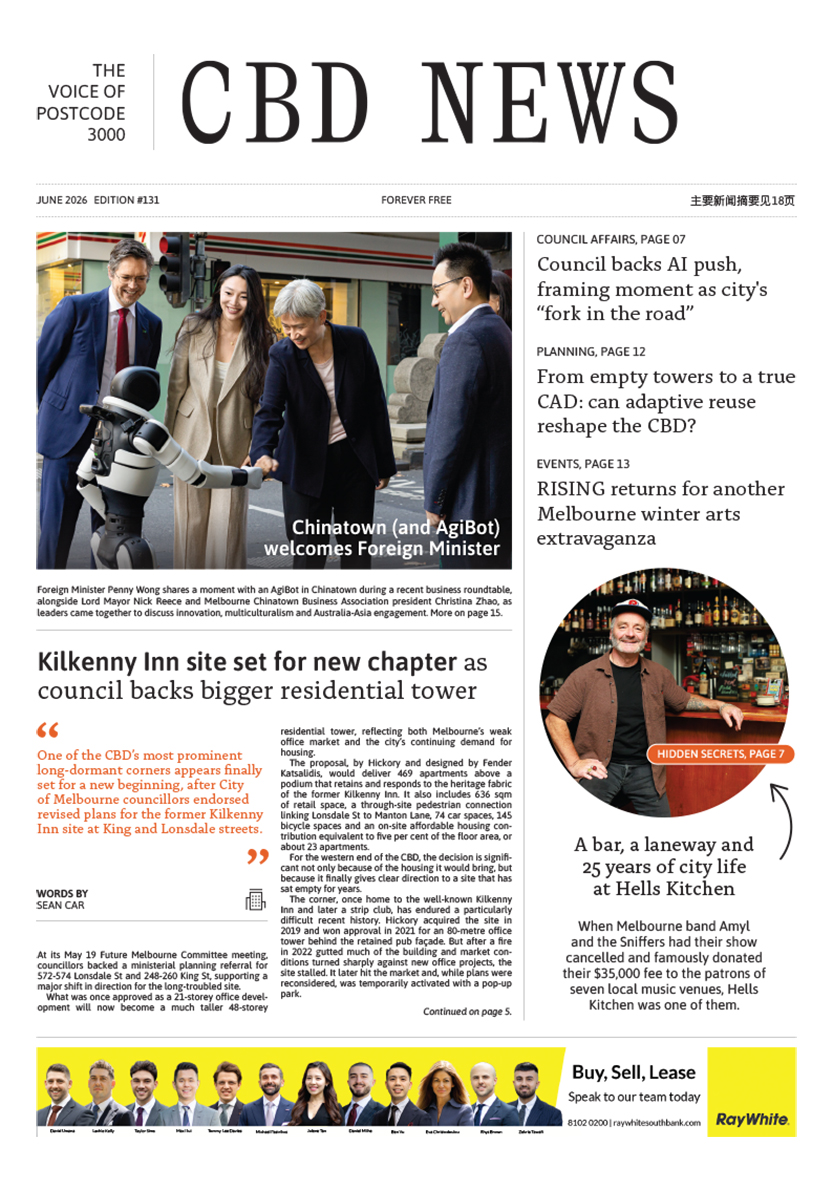 Download the Latest Edition