
From empty towers to a true CAD: can adaptive reuse reshape the CBD?
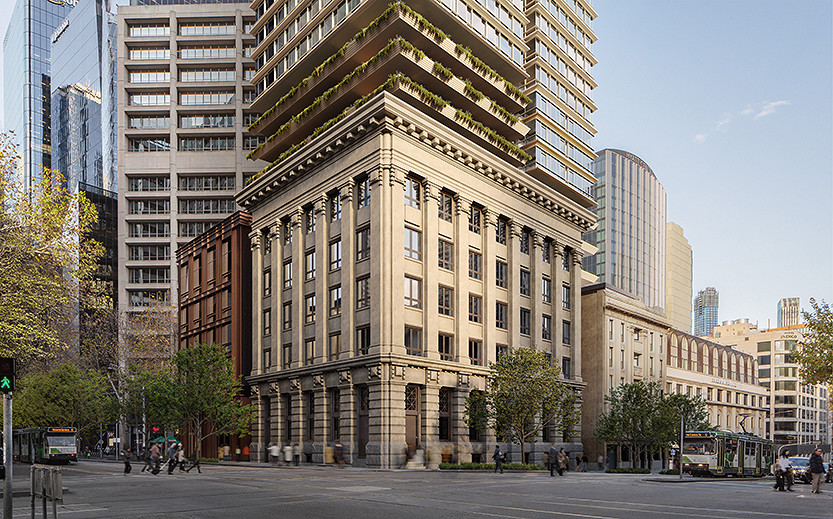

As the state government reviews long-criticised CBD developer incentives, a powerful new data tool from Plus Studio could help reveal which underused towers are ready to shift Melbourne from a Central Business District to a true Central Activity District (CAD).
Few issues now define the post-COVID future of Melbourne’s CBD more clearly than what to do with its underused office towers.
For years, city leaders, landlords and planners have wrestled with the same stubborn reality: while workers have returned in significant numbers, central Melbourne is still carrying more vacant and underutilised office space than anyone would have imagined before the pandemic. That has left property owners facing a more fundamental question than leasing strategy alone can answer: not just how to fill a building, but whether its best future use is still office at all.
That broader debate has now reached a more decisive policy moment.
The Victorian Government has confirmed it is updating Melbourne’s Central City Public Benefits Guidelines as part of a wider review of incentives under the Capital City Zone. In plain terms, that means revisiting planning settings that have long rewarded developers for delivering office space, even as the market has changed dramatically.
A government spokesperson said the updates were about supporting more housing, “including more affordable housing”.
“These changes are about getting more homes built while making sure the community continues to enjoy great parks, walking connections and public spaces,” the spokesperson said.
The government stressed that it had “made it clear” that it would fast-track approvals to convert eligible commercial offices and mixed-use properties into apartments, adding that it had established a working group with industry and councils to opportunities for conversions.
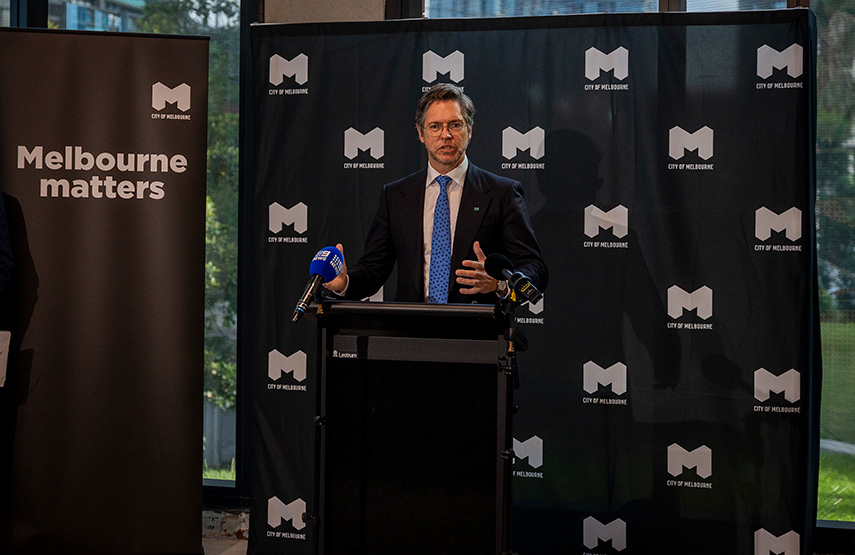
Lord Mayor Nick Reece at this year's draft budget announcement.
It follows growing pressure from the City of Melbourne, which argued late last year that the current uplift regime was out of date after a major Queen St proposal was able to unlock additional yield by including office floorspace as a public benefit.
Lord Mayor Nick Reece, who made office-to-housing conversion a central issue of his election platform, told CBD News during the council’s draft budget announcement on March 31 that the city had been in “very productive discussions” with the state government, but cautioned that the issue was proving “a harder nut to crack than certainly I had initially thought.”
That note of realism is important. Adaptive reuse is no longer just a catchy policy slogan. It is a highly technical, financially sensitive and often building-by-building challenge.
And that is exactly where architects like Ian Briggs and Mau Cheng from Plus Studio say the conversation needs to become more sophisticated.
Briggs, a director at the practice, says the first mistake people make is assuming adaptability is a single idea rather than a spectrum. Some buildings can be upgraded into better offices. Some can be repurposed into something entirely different. Some simply cannot be reused economically at all. But, significantly, he believes a large share of Melbourne’s stock is not beyond saving.

Plus Studios director Ian Briggs.
"If you put away the refurbishing of one office building into a more modern office building, it’s about 30 per cent of the CBD’s built form that has the ability to be repositioned from effectively an empty or underutilised space into brand new function," he told CBD News.
That figure suggests the city’s adaptive reuse opportunity is not marginal. It is structural.
Yet Briggs is equally clear that the old way of thinking about this issue, namely which office towers can become apartments, is already outdated. He argues that a narrow focus on build-to-sell housing misses how much the market has shifted in recent years.
Deeper floorplates once dismissed as unsuitable for apartments may still work very well for other uses, particularly build-to-rent or student accommodation. In those typologies, the building core can absorb communal areas, study rooms and shared facilities, allowing bedrooms to sit around the perimeter where light is available.
Plus Studio is already working on exactly these kinds of projects, including the conversion of a 1970s Bourke St office building into a 900-room student accommodation scheme. Briggs says office-to-student conversion can, in some cases, be easier than traditional apartment conversion because smaller rooms can “wriggle around spaces and columns” more readily than larger residential layouts.
The practice has also built a reputation in more heritage-sensitive repositioning work. At 623 Collins St, the former State Savings Bank of Victoria site, Plus Studio designed a major mixed-use redevelopment that retains and integrates significant heritage fabric into a new residential tower. Cheng, recently promoted to associate and a design lead on the project, says adaptive reuse only works when heritage is treated not as an obstacle, but as an asset.
But both Cheng and Briggs stress that adaptive reuse comes with hidden complexity.
Old buildings conceal surprises. Even newer commercial buildings can prove less orderly than expected once walls and ceilings come off. Columns do not always line up. Structures vary floor to floor. The lesson, Cheng says, is that developers need to allow more time, more contingency and more design iteration than they would for a straightforward new-build project.
That longer timeframe is one reason the economics can be so difficult. Adaptive reuse usually takes longer to design and longer to construct than knocking a building over and starting again. That means more holding costs, more complexity and more financial risk.
In that context, the incentive system becomes critical. Briggs argues that one major blind spot in current policy is environmental performance. At present, rating tools and public benefit structures tend to focus on the performance of the finished building, but do not properly recognise the carbon already saved by retaining and upgrading the existing structure rather than demolishing it.
“You’ve saved all the carbon inherent in the actual basic structure of the building that you haven’t knocked over,” he said. “That’s a really big thing that’s not understood well at certain levels.”
It is a point that aligns closely with the City of Melbourne’s Retrofit Melbourne agenda, which has pushed for stronger incentives to upgrade existing buildings rather than waiting for replacement stock.
Cheng adds that beyond planning reform, financial relief around holding rates or taxes for slower, more complex adaptive reuse projects could make a real difference.

Plus Studios associate Mau Cheng.
Former City of Melbourne finance chair Stephen Mayne argues the council should be far more willing to use its own balance sheet and taxation levers to encourage adaptive reuse, whether through targeted rate holidays, waived fees or grants for projects that actually commence within a defined timeframe.
At the same time, Mayne cautions against treating adaptive reuse as a wholesale solution that strips the city of future office capacity. Melbourne is still the central city, and it will continue to need workplaces. The goal, in his view, is not mass conversion for its own sake, but a selective approach that repurposes the right buildings for housing, education, entertainment or the arts, while allowing the market to retain the office stock the city will still need over time.
What makes this moment different, however, is that the industry may finally have a practical tool to work with.
Plus Studio has developed “AdaptAbility”, a new data-driven tool designed to identify which commercial buildings across the City of Melbourne have the strongest potential for adaptive reuse. It uses census information, 3D city mapping, property data, building age, heritage controls and architectural rules to sort buildings according to their best likely future use, whether that is upgraded office, apartments, build-to-rent or student housing.
In Briggs’s words, what once required months of due diligence can now be narrowed quickly into a far more targeted search. That has the potential to become a game changer, not just for developers, but for the city itself.
Because ultimately this is not only a property story. It is a city-shaping one.
Briggs strongly supports Reece’s suggestion that Melbourne should stop thinking of itself as a CBD and start thinking more ambitiously as a CAD, a Central Activity District.
The distinction matters. A CBD implies monoculture: office towers, workers by day, emptiness by night. A CAD suggests something more layered: housing, study, hospitality, culture, community facilities and public life all mixed together.
For Briggs, success over the next decade will not be measured simply by how many offices become apartments. It will depend on whether Melbourne can develop a more coherent picture of the city it actually wants, including schools, libraries, childcare and cultural hubs, and then use planning, incentives and data to bring those elements together.
The pandemic may have broken the old logic of the CBD. What happens next will depend on whether Melbourne can move quickly enough, and cleverly enough, to build something richer in its place. •
Buy our Journalists a coffee
Support our dedicated journalists with a donation to help us continue delivering high-quality, reliable news


Related Articles

The rise of the “third room”: How Australians are reinventing their outdoor spaces
There was a time when the backyard was an afterthought. A patch of grass, a rusting barbecue, maybe a plastic chair or two.
Read More
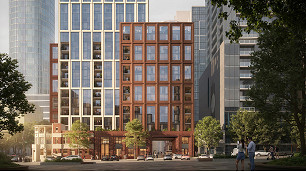
Kilkenny Inn site set for new chapter as council backs bigger residential tower
One of the CBD’s most prominent long-dormant corners appears finally set for a new beginning, after City of Melbourne councillors endorsed revised plans for the former Kilkenny Inn site at King and Lonsdale streets.
Read More
Council approves amended Russell St function centre, despite 36 objections
The City of Melbourne has backed an amended permit for the Space Hotel on Russell St, approving changes to a long-running proposal for a rooftop function centre after finding the revised scheme would deliver better heritage and amenity outcomes.
Read More
Council backs AI push, framing moment as Melbourne’s “fork in the road”
Kilkenny Inn site set for new chapter as council backs bigger residential tower

 Download the Latest Edition