
Premier’s public rebuke over work-from-home misses the mark
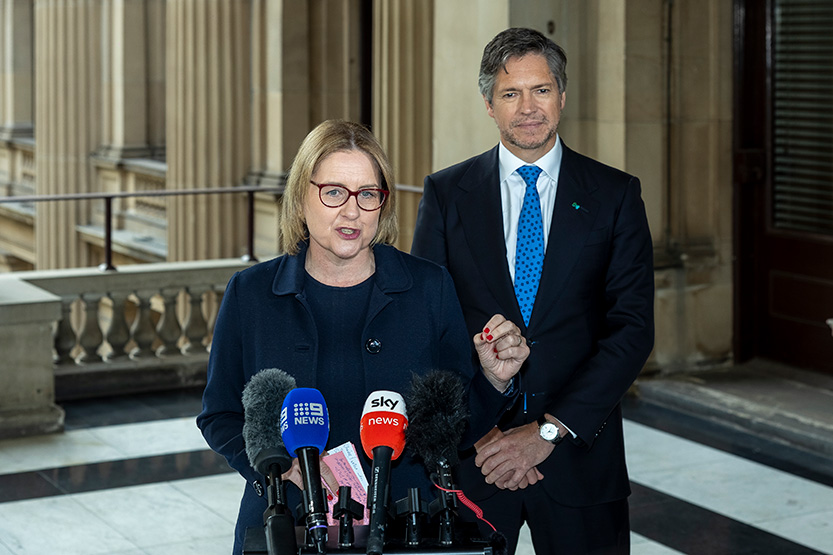
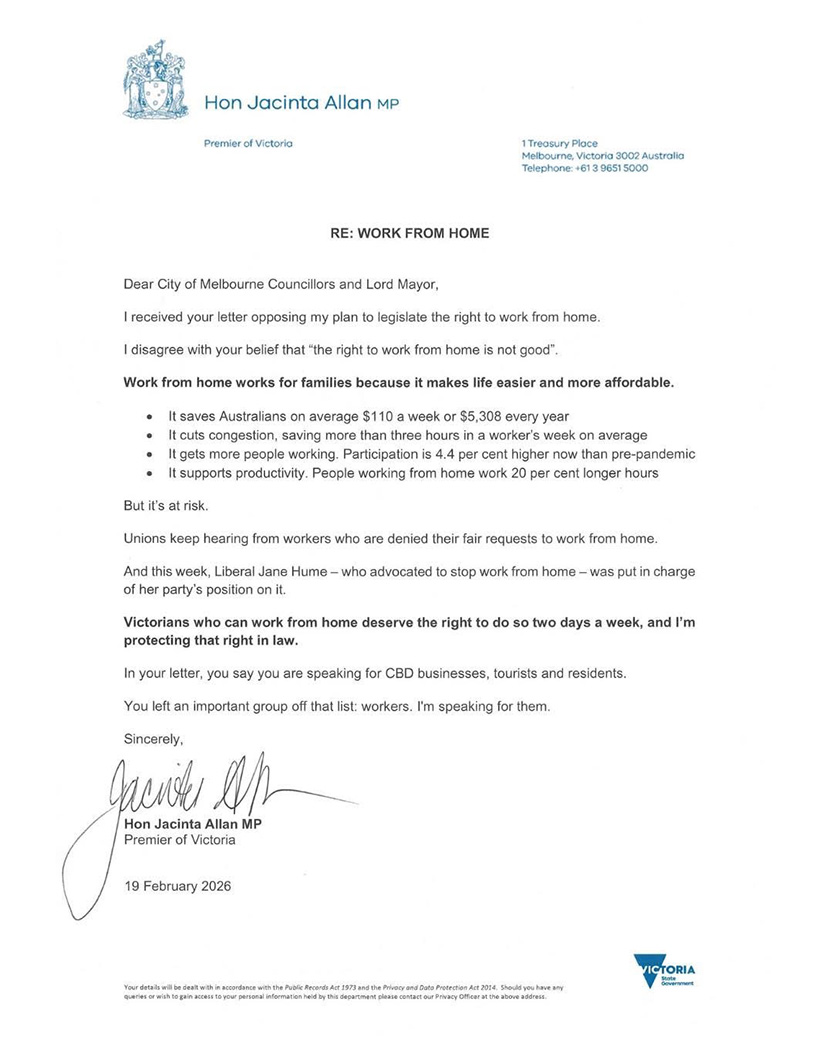

Premier Jacinta Allan’s decision to publicly release and promote her letter rebuking the City of Melbourne over its position on mandated work-from-home rights has added heat, but little light, to an already nuanced policy debate.
In her February 19 letter to Lord Mayor Nick Reece and councillors, the Premier rejected the council’s opposition to legislating a right for eligible employees to work from home two days a week.
“I disagree with your belief that ‘the right to work from home is not good’,” she wrote, before listing what she described as the economic and social benefits of working remotely.
She argued that working from home “makes life easier and more affordable,” citing savings of $110 a week for workers, reduced congestion, increased workforce participation and productivity gains.
“Victorians who can work from home deserve the right to do so two days a week, and I’m protecting that right in law,” she said.
The tone, however, was sharper than the substance warranted. The council has not argued that working from home is “not good”. Rather, its October motion made clear that flexibility should remain a matter for negotiation between employers and employees, not imposed through legislation.
Councillors expressed concern that a blanket mandate could further weaken Melbourne’s CBD recovery, increase office vacancy rates and undermine small businesses reliant on foot traffic. Their argument was about governance and economic strategy, not opposition to flexible work itself.
By framing the council’s position as an attack on workers, the Premier has simplified what is, in reality, a legitimate disagreement about where the line between government intervention and workplace autonomy should sit.
It is difficult to ignore the broader political context. The government has endured several bruising weeks, facing sustained criticism over CFMEU corruption allegations and questions surrounding cost blowouts linked to the Big Build. Against that backdrop, drawing a clear contrast with what can be portrayed as a “conservative” city council serves an obvious political purpose.
In her letter, the Premier accused councillors of leaving “workers” off their list of stakeholders. “You left an important group off that list: workers. I’m speaking for them,” she wrote.
That framing positions the state government as unequivocally pro-worker while casting the council as siding with business interests. It is a neat wedge, but not an entirely fair one.
The City of Melbourne’s vote reflected the concerns of CBD-based employers, hospitality operators and investors who remain anxious about post-pandemic recovery. That advocacy role sits squarely within the council’s remit. Local government is not charged with setting statewide industrial relations policy, but it is expected to defend the economic health of the capital city.
The Premier’s decision to take the exchange public, and to promote it heavily across social media, has elevated what could have remained a routine intergovernmental disagreement. A more measured approach – acknowledging the council’s concerns while defending the government’s policy – may have better served both institutions.
Instead, the exchange risks reducing a complex economic and social policy discussion to a binary culture-war style contest between “workers” and “the city”.
Work-from-home arrangements have become a defining feature of the modern workplace. There are reasonable arguments on both sides about whether rights should be legislated or left to enterprise-level negotiation. Treating the council’s position as inherently anti-worker obscures that nuance.
Ultimately, the debate is less about whether flexibility is desirable – most agree that it is – and more about who should decide its limits. That is a legitimate question deserving of thoughtful engagement.
Turning it into a public scolding may win short-term political points, but it does little to advance the substance of the policy discussion – or the cooperative relationship that state and city governments require to navigate Melbourne’s recovery.
Buy our Journalists a coffee
Support our dedicated journalists with a donation to help us continue delivering high-quality, reliable news


Related Articles

Council backs AI push, framing moment as Melbourne’s “fork in the road”
The City of Melbourne has backed a new push to prepare the city for the workforce disruption and economic opportunities created by generative AI, after councillors supported a motion from Cr Andrew Rowse at the Future Melbourne Committee on May 5.
Read More
ATET legal mess lays bare major questions for the City of Melbourne
The $7 million Supreme Court fight over Docklands floating events space ATET has now reached the point where the City of Melbourne can no longer plausibly present it as just another difficult regulatory dispute.
Read More
CBD budget doubles down on safety, support and a more walkable city
The City of Melbourne’s latest budget makes clear that, for the CBD, safety and street-level confidence remain the council’s central political and civic priority.
Read More
Council backs AI push, framing moment as Melbourne’s “fork in the road”

Kilkenny Inn site set for new chapter as council backs bigger residential tower

 Download the Latest Edition