
Reminders of wartime looms over Princes Bridge
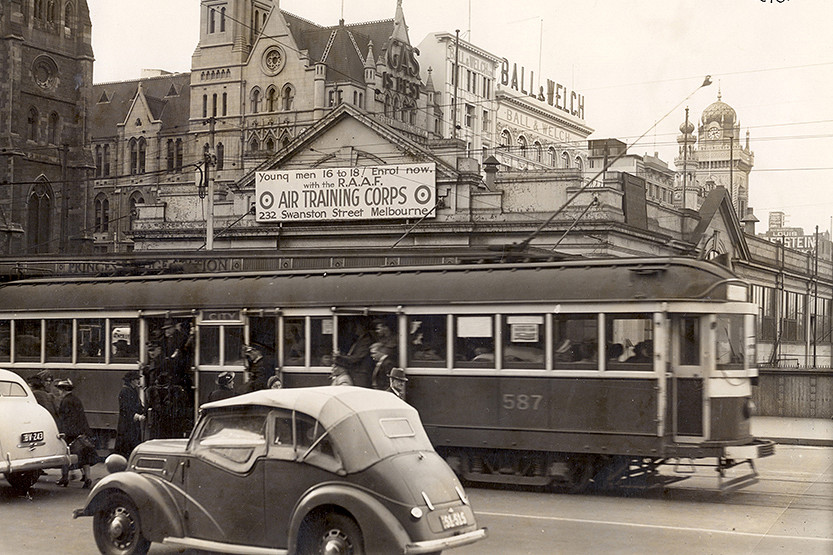

In the early 1940s in Melbourne, as war ravages overseas, life in the city carries on as normal at the corner of Princes Bridge and Flinders St.
Taken from the footpath of Flinders Street Station, the first thing you see is a bug-like car with a calico roof, followed by passengers unloading from a tram. Various landmarks can be seen in the background, including St Paul’s Cathedral, the Gothic Revival-styled Metropolitan Gas and Fuel building (with the “Gas is best” sign, built in 1892), the long-running drapery business Ball and Welch (which ran at Flinders St from 1899 until the 1970s), and the bulb-domed tower of the Forum Theatre.
At the far end is an advertisement for Louis Epstein, a popular tailor that began in 1905, eventually moving to its Flinders St store (known as Epstein House) in 1926, where it remained until the 1990s.
Behind the tram, fixed to the Princes Bridge Railway Station building (where Federation Square now sits), a prominent sign invites young men 16 to 18 to enrol for the RAAF’s (Royal Australian Air Force) Air Training Corps – a reminder in an otherwise ordinary-seeming scene that, out of sight overseas, a war is raging.
The Corps (now known as the Australian Air Force Cadets) was formed in 1941, with the aim of training youths for further involvement with the RAAF. The Corps moved into Latham House at 232 Swanston Street in around 1943, with one article in the Werribee Shire Banner (1944), offering youths looking for a career as aircrew or technical staff, the benefits of specialised education “for the cost of a postage stamp”, including science and mathematics, Morse code, navigation, aircraft recognition, and service knowledge. As typical of war propaganda of the era, it promised youths the experience would help develop their “physique, discipline, character, initiative, mental alertness and teach him to act and think for himself.”
Women weren’t left out in assisting the RAAF, through the voluntary auxiliary organisation, the Women’s Air Training Corps (WATC). Formed in Brisbane in 1939, the Victorian branch had its first meeting in December 1939 at The Block at Collins St. The Herald described the organisation’s aims were to “provide an emergency service of young women trained in handling aircraft, servicing, general aircraft knowledge, motor transport, office and store clerks, and other ground organisation” (1939) involving a six-week course. One of the women who outlined the corps constitution in that first meeting, Pilot Freda Thompson, advocated in The Herald (1939) that training women would prepare them to take over important jobs if men went on missions overseas, a progressive idea in a then-dominantly patriarchal society. For most of its existence, the WATC would run from the 7th floor of the Capitol Building in Swanston St.
Latham House was also home of the RAAF Locker Fund, a charitable organisation that invited civilians to donate money and goods to the soldiers of the air force. They would hold charitable events, such as a Christmas Fair held at Town Hall in December 1944, which the Standard (Frankston) later reported raised £800 (1945).
When the war ended in 1945, the RAAF would move out of Latham house, having fulfilled their purpose. But even with their propaganda gone, their role in providing for the war effort should not be forgotten. •
Photo: Royal Historical Society of Victoria.
Buy our Journalists a coffee
Support our dedicated journalists with a donation to help us continue delivering high-quality, reliable news


Related Articles
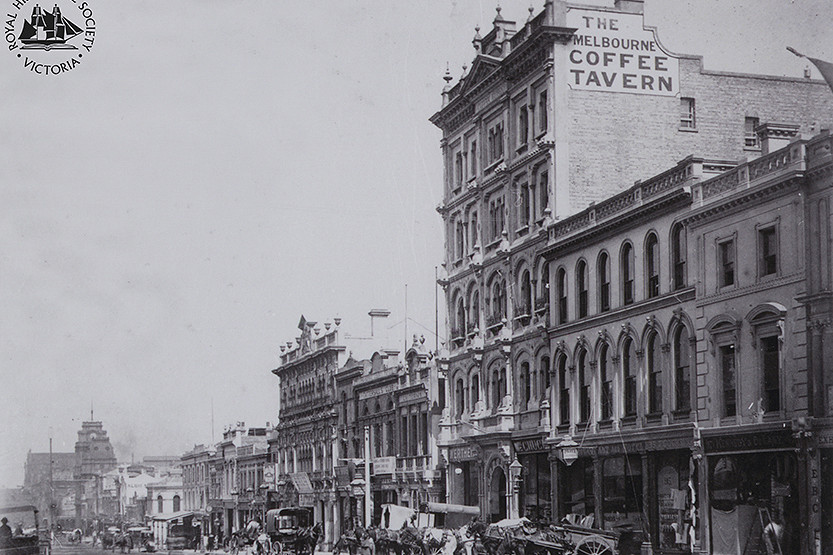
An escapee arrested at the Coffee Tavern
Opened in October 1882 on Bourke St between Swanston and Russell streets, the 90-foot-tall Melbourne Coffee Tavern featured 161 bedrooms and was also home to a sewing machine business owned by Hugo Wertheim.
Read More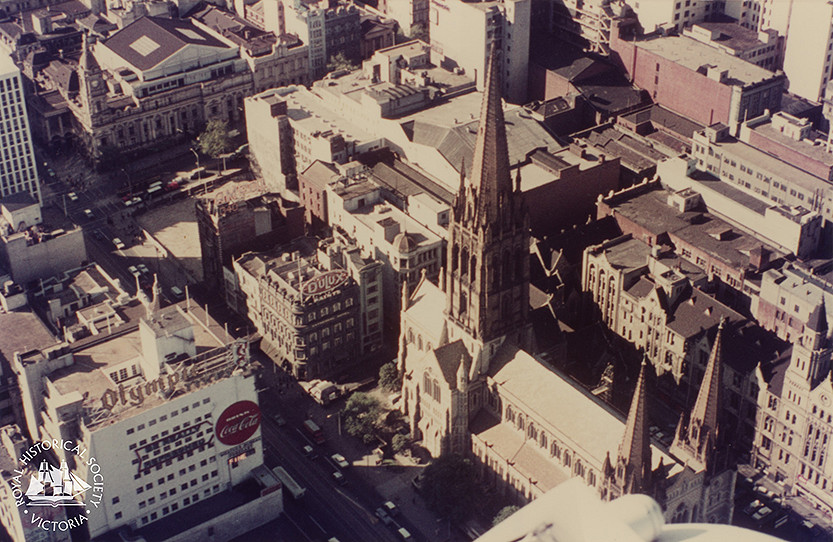
The beginning of a square, and the end of history
For those who are young or new to Melbourne, it might be a shock to discover that buildings once occupied the site of Town Hall Station, at the corner of Swanston and Collins streets.
Read More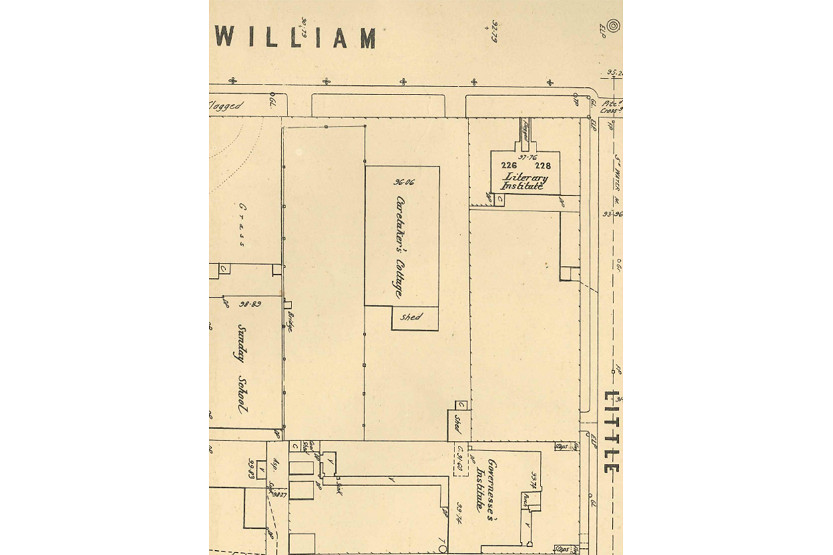
The Melbourne Home
In the late 19th century, a number of female immigrants fresh off the ship from England would arrive at Victoria with no planned accommodation or nearby connections that could help them settle.
Read More
Council backs AI push, framing moment as Melbourne’s “fork in the road”
Kilkenny Inn site set for new chapter as council backs bigger residential tower

 Download the Latest Edition